Why Naati Grains Introduced Traditional Bronze Utensils: Our Journey Towards Purity
- by Nivetha Sekar

Why Naati Grains Introduced Traditional Bronze Utensils
Naati Grains was founded with a clear purpose — to bring traditional, high-quality food products back into Indian homes.
Our primary business has always been cold-pressed oils. Even today, we continue to manufacture and provide traditional cold-pressed oils made with carefully selected ingredients.
Over the years, our journey with traditional foods made us think about another important question:
If we are so careful about what goes into our food, should we not also be careful about the utensils in which we serve and eat it?
This question led us to explore Traditional Bronze Utensils.
From Cold-Pressed Oils to Traditional Bronze Utensils
Our journey into bronze utensils was not a decision to move away from our core business.
Cold-pressed oils continue to be at the heart of Naati Grains.
Traditional Bronze Utensils are an extension of the same philosophy — bringing traditional products made with carefully selected raw materials into modern Indian homes.
Our ancestors used different traditional metals for different purposes. Brass was traditionally used for cooking, while bronze was commonly used for serving and eating.
We wanted to understand whether we could find genuinely pure bronze utensils for our own family.
That simple search became a much bigger journey.
Our Search for Pure Bronze
Instead of simply purchasing bronze utensils from the market, we decided to understand how they were actually made.
We travelled across several parts of India, including Tamil Nadu, Kerala, Karnataka, Andhra Pradesh, Maharashtra, Gujarat, Rajasthan, Delhi, Uttar Pradesh, West Bengal and Odisha.
We visited manufacturers, artisans and suppliers to understand the traditional bronze utensil industry.
What we discovered made us look much more closely at one important question:
What is actually inside a bronze utensil?
What Is Traditional Bronze?
Bronze is an alloy primarily made from copper and tin.
At Naati Grains, our Traditional Bronze Utensils are made with:
78% Copper + 22% Tin
This is a high-tin bronze composition, traditionally known as Kansa, Vengalam or Kanchu in different parts of India.
For us, simply calling a product "bronze" is not enough.
We want to know what metals are used and in what proportion.
Why We Chose Virgin Metals
During our research, we found that recycled and old scrap metal is widely used in the traditional metal utensil industry.
Old utensils may have been made at different times using different metal compositions. When different scrap metals are melted together, the exact composition of the resulting metal may not always be known.
For our family, that was not good enough.
So we decided that our Traditional Bronze Utensils should be made using carefully selected virgin raw materials.
We use:
- Virgin Copper
- Pure Tin
- 78% Copper + 22% Tin
- Lead-free raw materials
- Controlled metal composition
- No intentional addition of zinc
Our principle is simple:
Know the raw material. Control the composition. Maintain the quality.
Our Traditional Bronze Utensil Collection
Our Traditional Bronze Utensils are designed to bring the beauty and tradition of Kansa dining into everyday homes.
Our collection includes:
- Traditional Bronze Plates
- Bronze Tumblers
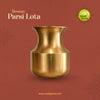
- Bronze Lota
- Bronze Katori
- Bronze Spoons
- Bronze Tiffin Plates
- Other traditional bronze serving and dining utensils
Each piece is made with the same focus on purity, traditional craftsmanship and quality that we believe in at Naati Grains.
Don't Choose Bronze Only by Its Colour
A bronze utensil may look beautiful and golden, but appearance alone cannot tell you its exact metal composition.
We believe customers should ask:
"What exactly is this utensil made of?"
The composition of a metal alloy can be professionally checked using equipment such as an XRF spectrometer at a suitable testing facility.
We believe in transparency and encourage customers to understand what they are buying.
Why Is Naati Grains Bronze Priced Higher?
Some customers ask:
"Why is your Traditional Bronze Utensil more expensive?"
The answer is simple:
Raw material quality matters.
There is a difference between using unknown recycled scrap and using selected virgin copper and pure tin with a controlled composition.
We do not want to reduce the quality of our raw materials simply to offer a lower price.
As a business, we maintain a fair margin to cover our operational costs. But we do not compromise on the raw materials used to make our products.
You are paying for purity, not just for the weight of the metal.
What Goes Into Your Body Is More Precious Than Gold
We carefully select the ingredients that go into our food.
We believe the same care should extend to the utensils in which we serve and eat our food.
When we buy gold, we look for purity because gold is valuable.
But what goes into our body every day is even more precious.
So don't choose a traditional bronze utensil only because it looks golden or beautiful.
Know the metal. Know the composition. Know what you are buying.
The Naati Grains Philosophy
Our journey into Traditional Bronze Utensils began with a personal search for our own family.
We wanted to combine the traditional way of eating with the same attention to quality that we have always applied to our food products.
That is why, while cold-pressed oils remain at the heart of Naati Grains, we have also brought carefully selected traditional products such as our 78% Copper and 22% Tin Traditional Bronze Utensils to our customers.
For us, this is not simply about selling bronze plates, tumblers, lotas or katoris.
It is about bringing tradition, quality and transparency back into Indian homes.
Naati Grains — Paying for Purity.
- Posted in:
- 78% Copper 22% Tin
- Bronze Katori
- Bronze Lota
- Bronze Plate
- Bronze Spoon
- Bronze Tiffin Plate
- Bronze Tumbler
- Bronze Utensils
- High Tin Bronze
- Kanchu
- Kansa
- Kansa Utensils
- Naati Grains
- Pure Bronze
- Traditional Bronze Utensils
- Traditional Dining
- Traditional Indian Utensils
- Vengalam